
Short answer
Most toilets that won't flush have a disconnected chain, a broken handle, or a flapper that never lifts. Lift the lid — the cause is visible in seconds.
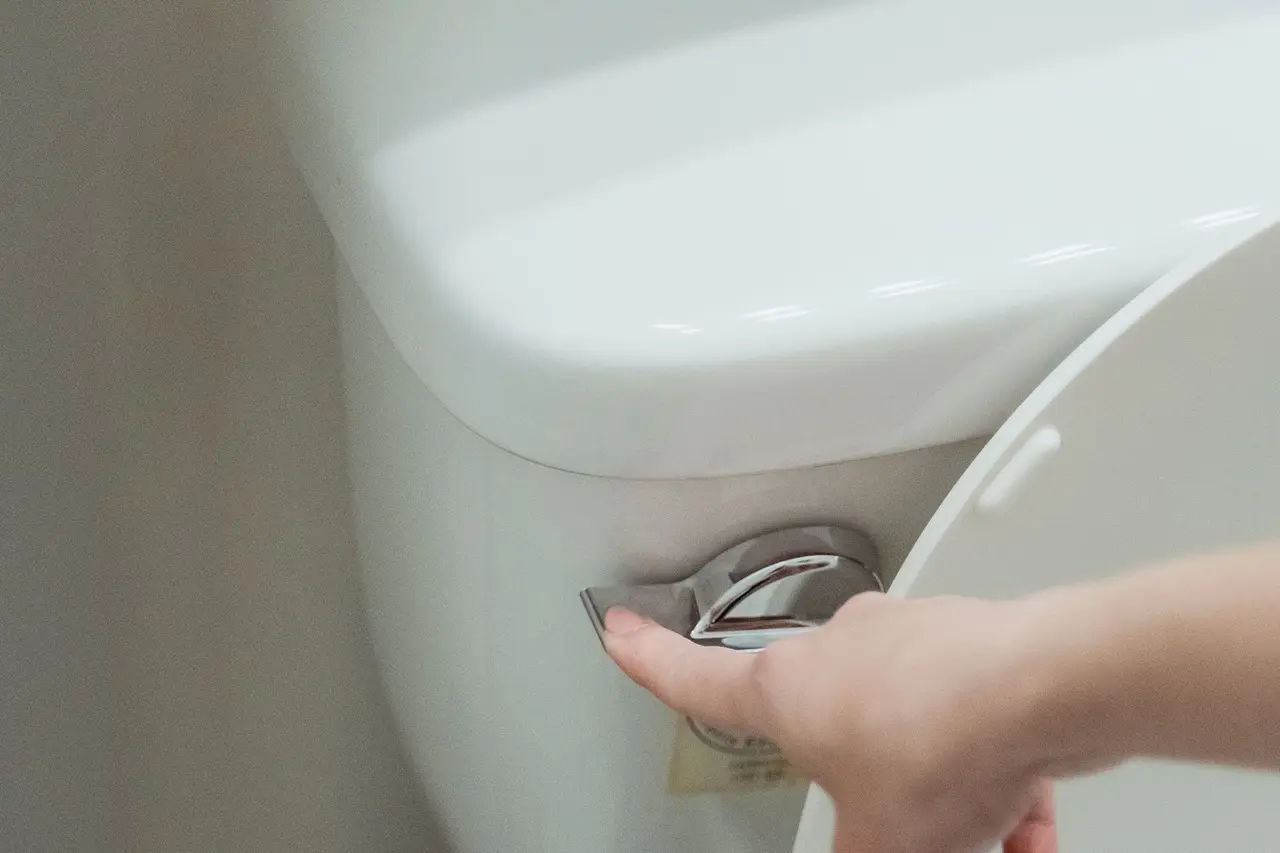
What kind of “won't flush” is it?
A toilet that won't flush fails in one of four ways, and each points to a different fix — so start by naming what yours does. If you press the handle and nothing happens at all, the flush mechanism inside the tank is disconnected or broken. If the handle feels loose or floppy, the handle or its arm has come apart. If the handle works but the flush is weak, short, or only half-empties the bowl, the tank is not delivering enough water, or the rim jets are clogged. And if the bowl fills with water but never drains away, the problem is a clog below the bowl, not the flush mechanism at all.
This matters because the wrong fix wastes an afternoon. A plunger cannot help a disconnected chain, and a new flapper cannot help a clogged drain. Spend one minute matching your symptom to the list above before you touch anything — the right section below will tell you exactly what to look for.
One distinction is worth making early: this guide is about a toilet that does not flush. A toilet that flushes fine but keeps running afterwards — water trickling into the bowl long after the flush — is a different problem, usually a flapper that no longer seals, and our running-toilet guide covers that repair. Here, the flush itself never happens or never finishes.
Lift the tank lid: the 30-second diagnosis
Almost every no-flush problem lives inside the tank, and the tank lid lifts straight off — set it down flat on a towel on the floor, because a cracked lid is an expensive accident. With the lid off, press the handle and watch what moves. In a working toilet, the handle turns a metal or plastic arm inside the tank, the arm lifts a chain, the chain lifts the flapper (the rubber disc covering the hole at the bottom of the tank), and tank water rushes into the bowl.
Now find where that sequence breaks. Is the chain lying loose in the water, unhooked from the arm or the flapper? Is the arm itself broken, bent, or spinning without turning? Does the flapper lift and fall straight back down, cutting the flush short? Or does everything move correctly, yet the water level sits well below the fill line marked inside the tank? Each answer is a fix in the sections below, and most of them need no tools at all.
While you are looking, check the obvious too. Make sure the water supply valve behind the toilet is fully open — a valve turned off during cleaning or a repair means the tank never refills, and a toilet with an empty tank cannot flush. The valve handle should turn counter-clockwise until it stops.
Fix 1: reconnect or replace the lift chain
A disconnected chain is the single most common cause of a toilet that won't flush, and it is also the easiest fix. The chain links the lift arm to the flapper, and it works loose over time — the hook slips off, a link corrodes and snaps, or the chain tangles on itself. If your handle moves freely and the flapper never lifts, the chain is the first suspect.
To fix it, hook the chain back onto the lift arm and onto the flapper's attachment loop, leaving about half an inch of slack when the flapper is closed. That slack matters: a chain pulled drum-tight holds the flapper slightly open, which causes running water — the problem our other toilet guide covers — while a chain with too much slack never lifts the flapper high enough to start a full flush. Press the handle and watch the flapper lift fully and stay up until the tank is nearly empty; adjust the hook position one link at a time until it does.
If a link is broken or the chain is rusted, replace it — a universal toilet lift chain costs very little at any hardware store and clips on with no tools. Take the old chain with you so the length matches, and trim the new one so it has that same half inch of slack rather than dangling in a long loop that can tangle under the flapper.
- Hook the chain to the lift arm and the flapper, with about half an inch of slack.
- Test the handle: the flapper should lift fully and stay up until the tank empties.
- Too tight = running water; too loose = weak or no flush — adjust one link at a time.
- Replace a rusted or broken chain with a universal one; trim it to the same slack.
Fix 2: a loose or broken handle and lift arm
If the handle spins loosely, wobbles, or feels disconnected from anything, the problem is the handle assembly itself. The handle mounts through the front of the tank and connects to a lift arm inside; that arm can snap — plastic arms become brittle with age — or the nut holding the handle can work loose, so turning the handle just spins it in place.
First try tightening the mounting nut inside the tank. One detail catches many people: the nut is reverse-threaded, so you turn it clockwise to loosen and counter-clockwise to tighten — the opposite of normal. Snug it firmly by hand, but do not force it with a wrench; overtightening cracks the porcelain, and a cracked tank is a replacement, not a repair.
If the arm is snapped or the handle itself is cracked, replace the whole handle assembly. It is one of the cheapest toilet parts: remove the nut, slide the old handle out, slide the new one in, and tighten the nut counter-clockwise. Handles come in front-mount and side-mount styles, so check which side of the tank yours is on before buying, and match the arm length roughly to the old one.
Fix 3: a flapper that won't lift — and low water in the tank
When the chain and handle are fine but the flapper still does not lift properly, look at the flapper itself. A warped, swollen, or mineral-crusted flapper can stick to the flush valve seat and need a hard tug to break free, or it can be so heavy with buildup that it drops shut the instant you release the handle, cutting the flush short. Rub the flapper's sealing edge with your finger — if it feels warped, wavy, or leaves black residue on your hand, it is worn out.
Replacing a flapper takes a few minutes: turn off the supply valve, unhook the chain, slip the flapper off the two pegs on the overflow tube, and press the new one on. Flappers are nearly universal — the common sizes are two-inch and three-inch — so measure the old one's diameter or the flush valve opening before buying. With the new flapper in place, reconnect the chain with that half inch of slack and test the flush.
While the lid is off, also check the water level. The tank should fill to the line stamped or marked inside the tank wall, usually about an inch below the top of the overflow tube. If the water sits much lower, the toilet simply has too little water to power a flush. The usual cause is the fill valve's float set too low: slide or screw the float upward — most modern fill valves adjust with a screw or a clip on the float arm — so the water shuts off at the marked line. If the fill valve hisses, refills slowly, or never shuts off, the valve itself is failing and should be replaced.
Fix 4: clogged rim jets and a weak, partial flush
If the handle, chain, flapper, and water level are all correct but the flush is still weak — the bowl swirls without emptying, or waste stays behind — the water is not getting from the tank into the bowl fast enough. The usual bottleneck is the rim jets: the small holes under the rim of the bowl where flush water enters. In hard-water homes, mineral scale narrows these holes over years until the flow drops to a trickle.
Look under the rim with a small mirror and a flashlight. If the holes are crusted with white or brown scale, they need cleaning. Turn off the water, flush to empty the tank, and pour white vinegar into the overflow tube in the tank — the tube carries it straight to the rim jets — then let it sit for several hours or overnight. After the soak, poke each jet gently with a piece of stiff wire or a wooden toothpick to clear loosened scale, scrub with a stiff brush, turn the water back on, and flush.
A related check: the small refill tube from the fill valve should point down into the overflow tube, not into the tank. If it has slipped out, the bowl does not refill to its normal level after a flush, and the next flush starts with too little water in the bowl — which looks exactly like a weak flush even though the tank mechanism is fine.
When the bowl fills but won't empty: a clog below the bowl
A bowl that fills with water and stays full is telling you the flush mechanism did its job and the drain did not. The blockage is in the toilet's own trap or further down the line, and this is the one no-flush scenario where a plunger is the right tool — but it must be a flange plunger, the kind with the narrow rubber extension at the bottom that seals into the toilet's outlet. A flat sink plunger cannot seal a toilet bowl and will only splash.
Set the flange into the bowl outlet, add enough water to cover the plunger cup if the bowl is low, and push firmly and steadily — short, sharp plunges, ten or fifteen of them, then check whether the water level drops. Repeat a few times. Never use a chemical drain cleaner in a toilet: the chemicals sit in the bowl, can crack porcelain, damage the wax seal, and create a hazard for anyone who later works on the fixture.
If plunging does not move the water after several rounds, a closet auger is the next step — it is a short, hand-cranked snake designed to navigate the toilet trap without scratching the porcelain. If you are not comfortable using one, or if the clog is past the trap, call a plumber rather than forcing it. And if flushing makes water rise in the tub or shower, or several fixtures drain slowly at once, stop: that points to a main-line blockage, and our sewer-line warning-signs guide explains why that is a professional job, not a DIY one.